How vLLM Semantic Router Trains Embedding Models and Publishes Them to Hugging Face
· 6 min read


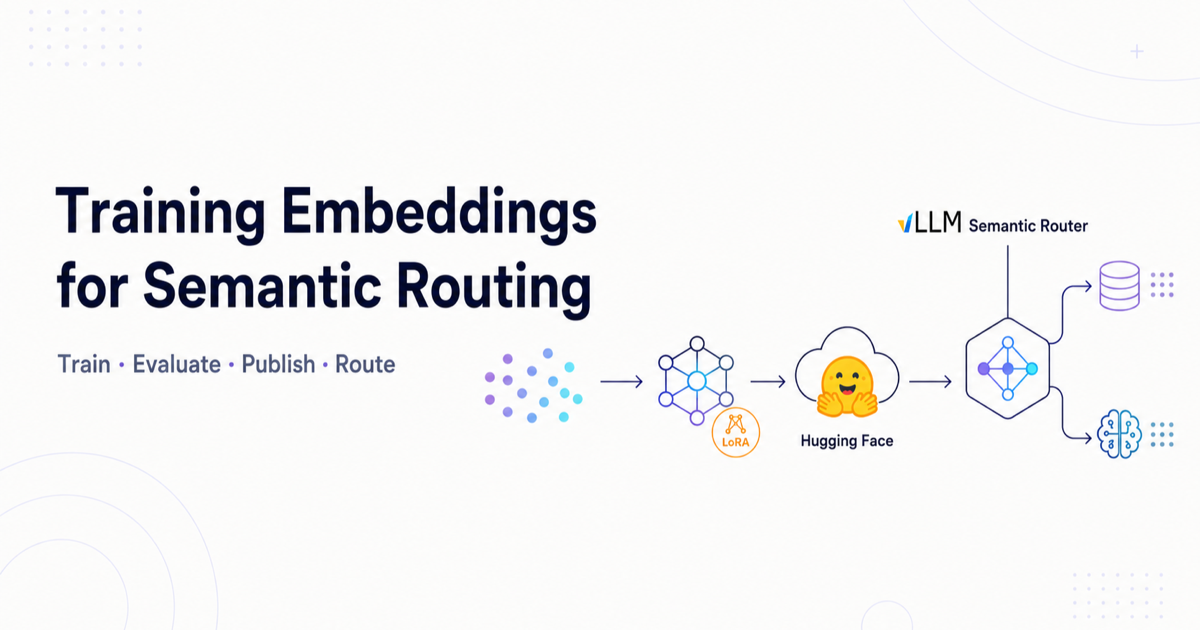
vLLM Semantic Router does not only forward prompts to one LLM. It classifies and routes requests using signals — keywords, classifiers, and embeddings.
Embeddings turn text into vectors. The router then:
- matches a query to category or anchor prompts (routing signals), or
- decides whether a new query is similar enough to reuse a semantic cache hit.
A general-purpose embedder (for example MiniLM) is good on average, but weak on specialized language (medical, law, code). So the project fine-tunes embeddings for those jobs, then publishes them on Hugging Face for everyone to download.